Wednesday, January 15, 2014

Education vs. Motivation

"Education is received extrinsically,
                              Motivation comes from within."


When it comes to training anything with any degree of seriousness it is necessary to take the time to become educated on the topics involved.  And in order to see that training develop into any degree of competence a certain amount of motivation must be in play.

We take an example of say... someone training to become a helicopter pilot.  In learning how to fly a helicopter one does not simply jump into the cockpit and start randomly toggling the controls expecting the thing to take off (although this may occur for an exceptionally lucky individual).  There is classroom study, independent study, a general understanding and knowledge base that must be absorbed and retained, at least on a rudimentary level, prior to a successful flight.  There are flight simulation exercises, practice programs and a great number of training tools utilized by the student in order to earn the receipt of his flight license proper.

As a general statement education is important and incredibly helpful prior to becoming proficient in any new skill, hobby, or activity.  As purveyors of a completely unique fitness program and body development system our first job is to educate the user to the best of our ability about how to really use the system and of course about common peaks and pitfalls.  When someone really learns a technique or exercise and becomes educated about it, that education will serve them for the rest of their life.


 Motivation on the other hand is equally as important, but plays another role.  An art student for example could read and learn about every brush technique known to man but without the motivation to pick up the brush and begin experimenting with and experiencing these techniques first hand his artistry only lies latent within.  This is where motivation enters.  Motivation can occur from any number of influences: a family member, a friend, a character, an athlete, a quote, a conversation, even... yourself.  Yes, indeed you are the most powerful tool you have to motivate yourself.  Yet many still struggle with taking action remaining content in lethargy or shackled by grandiose inertia.  This occurs on a widespread basis usually spawning from a lack of self-confidence or no desire for self-achievement / progress.  To those : BREAK OUT AND DO SOMETHING!  You will more than likely be pleasantly surprised.


Our approach is to take primarily an educational role.  As we continue and develop into what we are becoming one of our goals is to plant a seed.  This seed may flourish if nurtured properly and indeed can grow rapidly beyond belief.  Or this seed may lie dormant within forever.  As we release our system locally to our attending students and outward to the corners of the globe digitally we hope to provide enough information for anyone to become super human and to give them the means to educate themselves thoroughly enough to spark the necessary confidence in individuals to act and let their gains and their progress motivate them intrinsically.

As a learned pupil you will have all the means necessary to achieve your personal goals the only things left are easy, dedication and practice.  (I always think of the old Nike addage "Just Do It!")


Tuesday, November 19, 2013

Is Chi Shuo (Chi Sao) Applicable in Fighting?


Taken from an Audio Recording of Calasanz

==========


Chi Shuo vs. Figthing.

Let me give you the first concept or idea about reality towards this.


If you are a Wing Chun guy and you want to get close to me to do Chi Shuo and we are standing there the first thing I'm gonna say is you can't fight because you have to get to me.  Before getting to me... say I'm a guy from Holland, a striker  or a Thai boxer or something...  I am going to strike, so that gives me the edge towards you.

If we are standing close and both of us are killers then in Wing Chun the guy who is smarter is gonna win because remember in Wing Chun the guy who delivers the first 2 or 3 shots probably will win because it is electricity.

Put two electrodes together and there is an arc, a shock, electricity.  You see... If I fight Leung Ting I can be the loser or he can be the loser; with my power I have a little chance.  You know, everyone around me always said no matter who it would be, "Okay, Calasanz is gonna win."  People would joke, "If Mike Tyson and Calasanz get into the ring who is going to win?"

Everyone said, "Of course Calasanz."  

Today I say, "Get outta here!"  I never wanted to be against Mike Tyson anyway.  Back then maybe it would have been allowed, but with the UFC and MMA being the way they are today that fight would never happen.  You see, back then the UFC did not exist and I had done so much that people really thought I was not human.  Remember, we are talking about 1986, guy, people believed that I was something from another planet.

'seems like because from then, having been so well rounded at that point in time no one else was so multidisciplinary... and you were.'

"Exactly, Exactly, so that is why today I can put it together so... chi shuo, again if you are a fighter you don't want to start the fight at close range because now the wing chun guy is going to defeat you.  That is the difference between being a fighter and not being a fighter.

If you know Wing Chun Kung Fu and you're also a fighter you are the deadliest person on the planet.  But if you just know traditional Wing Chun and you are facing a fighter, now you have to be careful.  Leung Ting can be against a UFC fighter, but if he is not ready to take the punishment the fight might not go his way.  This is what happened in "Fighting Black Kings" when most of the Japanese defeated the Chinese.  The Chinese were just regular people doing Wing Chun as regular people.  They were not competitors like the Japanese preparing for punishment and training for the fight you know?

Now you're on the street getting ready to fight the person... if the guy knows the same amount of Wing Chun as you, you are not going to fight him.  The wing chun guy, the kung fu guys don't fight on the street.  The two of you are going to end up as friends.  "Oh you train Wing Chun and I train Cheng Chuan Longfist.  Okay, you teach me Wing Chun and I will teach you my kung fu."  But if one of you doesn't know martial arts then there is going to be a fight.  Now the Wing Chun guy is gonna take the street fighter and have him by the nose.  This is what you would do to a street fighter with wing chun.  But again, the guy didn't know how to fight, and that's the difference.


When you're talking about the guy who is trained to be a fighter going up against a guy trained in Wing Chun doing traditional chi shuo and is a very good martial artist, but isn't a competitor start from far because then you have the edge.  You can probably kick or punch the guy.  But the minute you touch the Wing Chun guy as a street fighter with no Wing Chun you have to be ready mister.  How are you going to block 11 attacks?  That is why boxers don't block.  They have to cover.  If the boxer could block that onslaught they would be blocking, but Wing Chun is more than that.  Wing Chun is electricity.  It's not just that the Wing Chun guy is throwing 11 attacks, its 11 attacks followed by blocks.  Look at the Wing Chun punch, there was no block, but there was a block.  The punch is a block and a block quickly turns into a punch if the guy is not going to block.  If the punch is thrown he's gonna block.  But the guy that doesn't know doesn't feel and ends up getting hit because he just tries to act.

So still some cannot understand why the Wing Chun guy is faster than the boxer.  Of course, the boxer defends.  The Wing Chun guy doesn't defend.  Defense and Attack go together; one technique.

One of my students A. R. (name abbreviated for privacy) said, "I was on the street and all of a sudden I see five guys on the ground, but I don't know what he did."  If you know Wing Chun immediately you're going to make the assumption, "That must have been Wing Chun."  So this is a real story.  He recounted it several times and was disappointed.  It was funny, he said he should have taken Wing Chun.  Later when he found out, when he saw Wing Chun, he said that was exactly what he saw (Wing Chun).  Five guys on the ground that didn't know what hit them.

So yeah, Wing Chun and Chi Shuo are good for the street, but going into a cage against a trained fighter you are gonna want more than just traditional Wing Chun Kung Fu.

==========

Sunday, November 10, 2013

Calasanz Remembers Moy Yat

Taken from an audio Recording of Calasanz


==========


I remember I was looking for northern styles of Chinese kung fu.  I already had read about Wing Chun Kung Fu and I knew that two of the main styles in China were Long Fist, that is Cheng Chuang Long Fist and of course Wing Chun I knew about because of Bruce Lee.

My friend Angel said to me, "No, no, no.  Go to Moy Yat.  He was a classmate along side Bruce Lee."

Moy Yat
So I went to Moy Yat.  I went to his school in China Town and immediately paid $50 dollars.  They put me in front of the mirror...  I remember it so clearly.  We were in front of the mirror and they put me into a stance like a pigeon, the traditional Wing Chun stance, and showed me the first few techniques.  The lesson was Tan Shuo, with the left hand, heun, and chamber and then the same with the right hand.

"Okay, that's it for today."  they said.  I responded almost in disgust, "That's it for today?  You must be kidding.  You must not know who am I."
I started doing pushups, exercises... the incredible, doing all these things.  They got angry, but they let me stay there.

You see, when I came to this country with that dream of being Bruce Lee nobody was going to stop me.  Nobody stopped me.  I was the craziest little bastard, little gorilla, chimpanzee, black cat, cheetah... unstoppable.

During my first few weeks at Moy Yat's school I became well known very quickly.  People would come in to fight the Chinese; you know back then it was different from how it is now.  I remember specifically two occasions.  There was one guy, he must have been about 6' 4, easily 3 times my size.  He came in and we ended up doing Chi Shuo.  We were trapping and hitting each other for over an hour, but neither one of us said 'Uncle'.  It was one of the only times I would take punishment, I delivered a fair share of punishment to him as well.

While I was doing Chi Shuo with this guy the Chinese were all around looking, talking, murmuring among themselves out of the sides of their mouths behind open hands.  You see, at this point I was new at Moy Yat's school and didn't have any training in Chi Shuo, I was just reacting to him.  Fortunately, I already had the necessary skills involved from training with George Wood.  He would hold two sticks and I would rotate with the two sticks as he held them for me.  So that gave me the ability of chi shuo.  I must have ended up winning because the guy never came back. 


The other occasion took place, when a guy came in, again, to fight the Chinese.  He was sweeping and flipping them onto the floor like nothing.  They were landing very hard.  Luckily it was a wooden floor because they were landing very, very hard.  He was unimpressed.  "I come to Moy Yat and this is how they fight?"  Understand, a lot of the people training there had never even seen the dummy, let alone hit it.  They never did anything but Siu Nim Tau and rotating in chi shuo, so they couldn't take a shot, they could not fight.  He came over to me and I said, "Try doing that to me. "  When he came and delivered that kick to sweep me I did exactly what I did in the Dominican Republic.  I grounded my leg.  He came to sweep me but failed because I had grounded my leg so well and immediately I countered him.

*Boom*  

You should have seen the Chinese when I came through the door the next day.  They started whispering; I remember one lady, this one little girl in particular, I will never forget.  She was the best of the best, probably only 75 pounds but she moved like a little cat.  She watched me non-stop, but I hear her murmuring still to the others, 'wshewsewshs... 10th degree black belt.' as she looked at me out of the corners of her eyes.  "This guy is black belt, he's 10th degree black belt, watch out for this guy shwhshsh."  They just talked and talked and talked.


Later on, Jon, a guy who worked for Moy Yat and who was responsible for bringing some of the bigger names in Martial Arts at the time to the school, came to me and said, "Go talk to Moy Yat."  So I went to the office and sat down there.  Moy Yat tells me, "Calasanz, we already know the skill you have."  He said, "Pay me this much and in 3 months you can teach, in one year you will have a certification and a picture with me."  It was exactly like that.

I went directly to Steve James, my boss at Victoria Station.  I said, "Steve, if you give me Saturday opening at 7 am and closing at 5 in the morning I can take wing chun with Moy Yat."  At that point I was the number one bus boy / waiter / employee there.  He said, "Of course Calasanz."  And I worked.  I worked all day and night, 22 hours.  By the time it was 5 in the morning I had about 7 or 8 hundred dollars cash plus whatever my hourly pay was at the time.  I had made the money for Moy Yat working at Victoria Station on a Saturday in just one day.
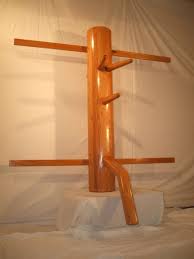

So I paid Moy Yat what he asked along with a $500 dollar fee which was what he charged anyone just to touch the dummy.  Normally nobody can see the dummy.  It was kept in a back room; maybe you could see it looking through a crack in the door, but it was kept away from the main area.  The minute anyone gave him the payment he led them to the room, took a key and locked the door.  I remember he led me there and locked the door and turned to me and said, "Okay Calasanz.  Now we go."  I'll never forget that.  At this point I am being trained privately by Moy Yat.  A lot of people who used to go there say, "But I never saw Calasanz there."  It's because I was in the back room working on the dummy.  The first day he gave me 'section 1' of the dummy and said, "Do section 1 as many times as you can.  Spend one week on section 1, then I can give you the entire dummy in 1 day if you want."  Exactly like that.

Here, this is a real story now.  This is real.  This is exactly how it happened.  When I finished there I spent 3 days just hitting the dummy.  I looked down at my arm there was nothing there.  It's all gone, all the hair on my arm gone, the skin almost gone.  It looked exactly how it looks when a snake peels its skin.  All the skin is gone, just peeled.  Think about it... hit the dummy for 1 day and still that is not going to happen.  I spent three days hitting it.  So now maybe you can understand what was the extent of the obsession that I had, that I hit the dummy enough to peel my arms entirely.  That was me Mr. Alan.  This is how, and that is the obsession that I had with being better than Bruce Lee.

Once I had completed that year we went to this cannoli place in Chinatown.  He was supposed to bring the picture and the diploma but he must have forgotten them.  Years later in 1988 I had him here for a seminar and even after calling him again and again to remind him,  "Make sure you bring the diploma."  he still didn't bring it.  You know, maybe if we do everything we can it could be that it is still over there.  Maybe someone in his family or someone over there has it because I know he would not break it or get rid of it.

Later on I figured out why he didn't want me to go and get the diploma.  Previously I had paid him no insignificant sum of money for a video of him on a projector doing the 3 forms.  Siu Nim Tao, Chum Kiu and Biu Tze.  I have the projector sitting right here in my office.  Not too long ago a good friend and long time student of mine, Mario, went to take a video of it from the projector so we could have it digital or whatever.  Ends up that on it was one of his students, a child maybe 11 or 13 years old, who was studying there at the same time as me doing siu nim tao.  So it wasn't even all three forms or done by him.  I wouldn't mind getting the forms from a kid anyway but that was a lot of money for Moy Yat to do it.  Anyway, probably he didn't want me coming and asking about that too if I went to get the diploma. 


Moy Yat, he was a good instructor.  He did what a good instructor does, you know.  He realized who I was.  He did not go and say, "Calasanz let me try to give you a lesson." and beat me up, not that he could have anyway at that point.  I respect him but he never had the capacity of giving me a lesson like that.  But he could have said that.  Instead he called me and said, "I'm gonna teach you."  That's what a good instructor does.

It's like me now.  When I see someone like that, dedicated and has passion for the Art I don't go trying to beat them up.  I want to raise them up.  For example, now I am building some of the youngest and most well rounded martial artists, the youngest masters I call it.  It's tremendous what someone with that sorts of mind-set, dedication, passion, desire and devotion to the Art is capable of learning and achieving even at a young age.  It's Incredible.

==========

Monday, October 28, 2013

Alignment through Bodily Awareness and Martial Art

It is no secret that Bodily Awareness and Martial Art go hand in hand.  From continued practice any student can develop proprioception, exteroception, balance and grounding to an astounding degree over time.

Hand-eye coordination will become greatly enhanced.  Awareness will be amplified.   Awareness not only of yourself but also of your surroundings will pour in and be reflected through your action.  Confidence will radiate from you naturally through how you carry yourself.


When it comes to Calasanz' Physical Arts exercises these qualities are being absorbed and developed during concentrated and focused training.  Again, you must be careful.  As you train pay attention to your body and the signals it is giving you.  While a bit of "pain" normally accompanies the exertion and eventual exhaustion of muscles and tendons it is important to remain cognizant of what is too much or too far or too incorrect.  Stubbornness, ignorance and negligence will lead to injury.  Train smart.  Listen to your body.  Make adjustments.  Keep your wits about you and do not take anything on blind faith or false belief alone.  Revisit your technique regularly with honesty and integrity towards improvement and perfection.


Monday, October 21, 2013

Martial Arts and the Perfectionist

"Don’t be afraid to correct perfectionists because you feel it will upset them. An instructor who feeds into this is not really teaching. Constant praise is counterproductive and doesn’t help the student learn."


I appreciate martial arts students who want to do everything perfectly. They are usually very committed and hard working.  They sign up for classes ready to train and full of enthusiasm.  Unfortunately, this enthusiasm disappears very quickly.  The one problem is that perfectionists worry themselves to death.  They start off with a very positive attitude, but set the bar so high that they get depressed and disappointed if they can’t meet their expectations often times allowing the slightest error to completely deflate the moment and block reception of the lesson.

Students with such high anxiety also tend to ask a lot of questions and over-analyze the lesson or the techniques.  What happens then is that instead of enjoying their martial arts training, it becomes stressful.  Some don’t want to take promotion tests because in their minds, they are never really ready.  Usually they are of the mind that nothing they do is ever good enough.

I’ve taught martial arts for over 30 years because I love teaching.  I've said it again and again, I don’t like to give up on anyone, perfectionists included.  They can be superior athletes if trained properly.  My best approach is to encourage them to lighten up.  I have to constantly remind them not to be so hard on themselves.

I will limit the amount of questions I allow during a class.  As a sincere teacher and instructor I can’t ignore all questions because some are legitimate but sometimes the barrage of inquisitions gets out of hand.  A martial arts class, however, should not consist of a lot of chit-chat.  Most people want to work up a sweat and learn the art; talking simply inhibits the experience.  Too many questions can also bore and even agitate the other students so maintaining focus on everyone getting a good workout is important.

During open workout sessions,
I specifically direct perfectionists on what they should work on for that hour.  Some students are so self-directed that they show up to an open workout with an agenda of what they want to work on and can keep themselves busy for an hour.  Although, if the Perfectionist needs a plan... Give it to them!  They will rise to the occasion.

Don’t be afraid to correct perfectionists because you feel it will upset them. An instructor who feeds into this is not really teaching. Constant praise is counterproductive and doesn’t help the student learn. Make constructive corrections and tell the student how to improve!

Above all, focus on the overall learning experience!  When directed by a knowledgeable instructor perfectionists have the potential to be, to become, outstanding Martial Artists.  Encourage them to enjoy the journey!


Friday, October 11, 2013

Smart vs. Mindless Training

Taken from an Audio Recording of Calasanz

 ==========


I have what we call upstairs 'science training'.  I can change someone in one hour.  I can change someone in half an hour.  That is how I developed a name, a good name, with Police Officers and Law Enforcement in general.  There are countless officers I have trained and given them this short amount of time to dramatically improve their job and ability to perform their duties on the street.  It takes me half an hour to teach them how to do the job better in respect to striking, subduing, general appearance, how to look and how to close the gap.  Since the 80's I've been known for that type of intensive training.

Not long ago I took in a student who had been attending lessons elsewhere for the past 6 months or more.  By the time I had spent 3 hours with him he already learned more than what he had gotten over the past six months.

When it comes to this topic, it is different from the subjects of kyokoshinkai and Mas Oyama, but it can be connected based on what it was that made us win those tournaments.  We won those tournaments because of what I could do with a person in 3 months, what I could turn a person into in that amount of time.

What I do for someone in 3 hours other trainers cannot do in 6 months, a year, 2 years, 3 years...  some probably take more than that.  What I can do for someone coming from a soft business school of taekwondo as a 6th degree black belt earned over 15 years or more... I can give that to them in just 3 or 4 hours of 'science training'.  Don't forget, Bruce Lee said, 10 minutes of smart training is better than 3 hours of 'mindless' training or 'dumb' training, however you want to call it.


You see, there is the difference.  You can do an hour of any sort of training without learning anything or you can do something smart for one hour and learn something.


 ==========

Sunday, October 6, 2013

Real Power through Simplicity

The Straight-Forwardness of Wing Chun Kung Fu


In the world of engineering often times the most celebrated solutions are also the most simple.  When it comes to martial art there is none more simple than Wing Chun


Review this video, especially those of you who have studied Wing Chun traditionally.  We love traditional wing chun programs but have also managed to cross the threshold by developing Wing Chun into something practical for more than just self-defense and street survival.

Calasanz studied Wing Chun under Moyat privately investing probably 3 times more than those who just love to talk.  When it comes to Wing Chun, even if you are not an expert or even if you are a beginner, just by taking Wing Chun you are already better than many other martial artists.  No matter what you do, no matter how abysmal your Wing Chun is, you are still getting 90% more than what you would get from any other martial arts school granted you are not making a concerted effort to ignore the lesson or refuse any sort of attempt at understanding the system.


Calasanz built his name by giving lessons to professional fighters who needed it.  You see, Wing Chun on the street is unmatched, but most guys who fight on the street don't know how to fight.  It's easy to win a fight on the street.  Watching a Wing Chun guy take down 10 guys on the street would only naturally make one of the mind that Wing Chun is best.  But again, those guys on the street probably are not good fighters.  So, when it comes to stepping into a ring, or now a cage you encounter a completely different animal.  Now you are fighting a fighter, a gladiator.  Now you are fighting someone who trains to fight.

That being said, Wing Chun designed for competition has to be more than just the traditional.  It has to evolve into something beyond.  While the traditional has much to offer in the marks of technique, body mechanics, spiritual development and general fitness it must be augmented for the cage when faced with the reality of fighting and with the knowledge and input gathered over time in order to participate in evolution proper.  Keep in mind, however, that evolution does not imply greater complexity.  In fact, it may even imply a step in the opposite direction towards greater simplicity.
 
Jeet Kune Do developed by Bruce Lee for example.  Lee introduced that concept of 'longest weapon attacks nearest target' which is undeniably and obviously sensible yet was strangely overlooked or undervalued for so long until its more recent revelation.  JKD was developed by Bruce Lee because upon coming to America he ran into trouble taking traditional Wing Chun into competition; meaning it needed to be converted into something effective for use in the ring against those trained to fight.  Behold the creation of JKD, behold the evolution of Wing Chun.